Images
Transcription below
Transcription
Done by AI (don't trust 100%)
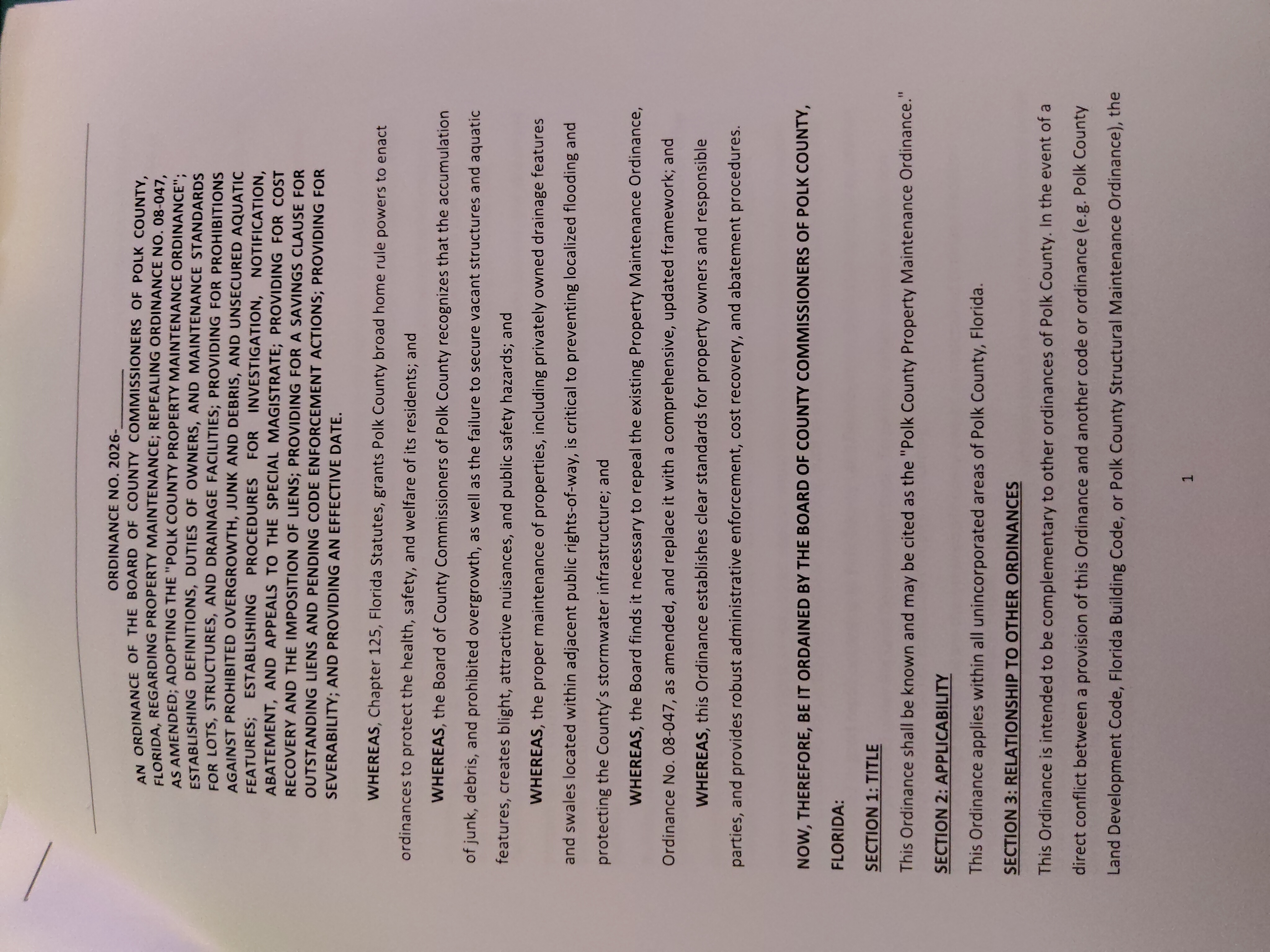
          ORDINANCE NO. 2026-

AN ORDINANCE OF THE BOARD OF COUNTY COMMISSIONERS OF POLK COUNTY, FLORIDA, REGARDING PROPERTY MAINTENANCE, REPEALING ORDINANCE NO. 08-047, AS AMENDED, ESTABLISHING THE POLK COUNTY PROPERTY MAINTENANCE ORDINANCE; ESTABLISHING DEFINITIONS, DUTIES, AND MAINTENANCE STANDARDS; FOR LOTS, STRUCTURES, AND DRAINAGE FACILITIES; AND PROHIBITING UNSAVORY FEATURES; ESTABLISHING PROCEDURES FOR INVESTIGATION, NOTIFICATION, ABATEMENT, AND APPEALS TO THE SPECIAL MAGISTRATE; PROVIDING FOR COST RECOVERY AND THE IMPOSITION OF LIENS; PROVIDING FOR A SAVINGS CLAUSE FOR OUTSTANDING LIENS AND PENDING CODE ENFORCMENT ACTIONS; PROVIDING FOR SEVERABILITY; AND PROVIDING AN EFFECTIVE DATE.

WHEREAS, Chapter 125, Florida Statutes, grants Polk County the power to enact ordinances to protect the health, safety, and welfare of its residents; and

WHEREAS, the Board of County Commissioners of Polk County recognizes that the accumulation of junk, debris, and prohibited overgrowth, as well as the failure to secure vacant structures and aquatic features, creates blight, unattractive nuisances, and public safety hazards; and

WHEREAS, the proper maintenance of properties, including privately owned drainage features and swales located within adjacent public rights-of-way, is critical to preventing localized flooding and protecting the County's stormwater infrastructure; and

WHEREAS, the Board finds it necessary to repeal the existing Property Maintenance Ordinance, Ordinance No. 08-047, as amended, and replace it with a comprehensive, updated framework, and

WHEREAS, this Ordinance establishes clear standards for property owners and responsible parties, and provides robust administrative enforcement, cost recovery, and abatement procedures.

NOW, THEREFORE, BE IT ORDAINED BY THE BOARD OF COUNTY COMMISSIONERS OF POLK COUNTY, FLORIDA:

SECTION 1: TITLE

This Ordinance shall be known and may be cited as "the Polk County Property Maintenance Ordinance."

SECTION 2: APPLICABILITY

This Ordinance applies within all unincorporated areas of Polk County, Florida.

SECTION 3: RELATIONSHIP TO OTHER ORDINANCES

This Ordinance is intended to be complementary to other ordinances and another code or ordinance (e.g. Polk County Land Development Code, Florida Building Code, or Polk County Structural Maintenance Ordinance), the

1

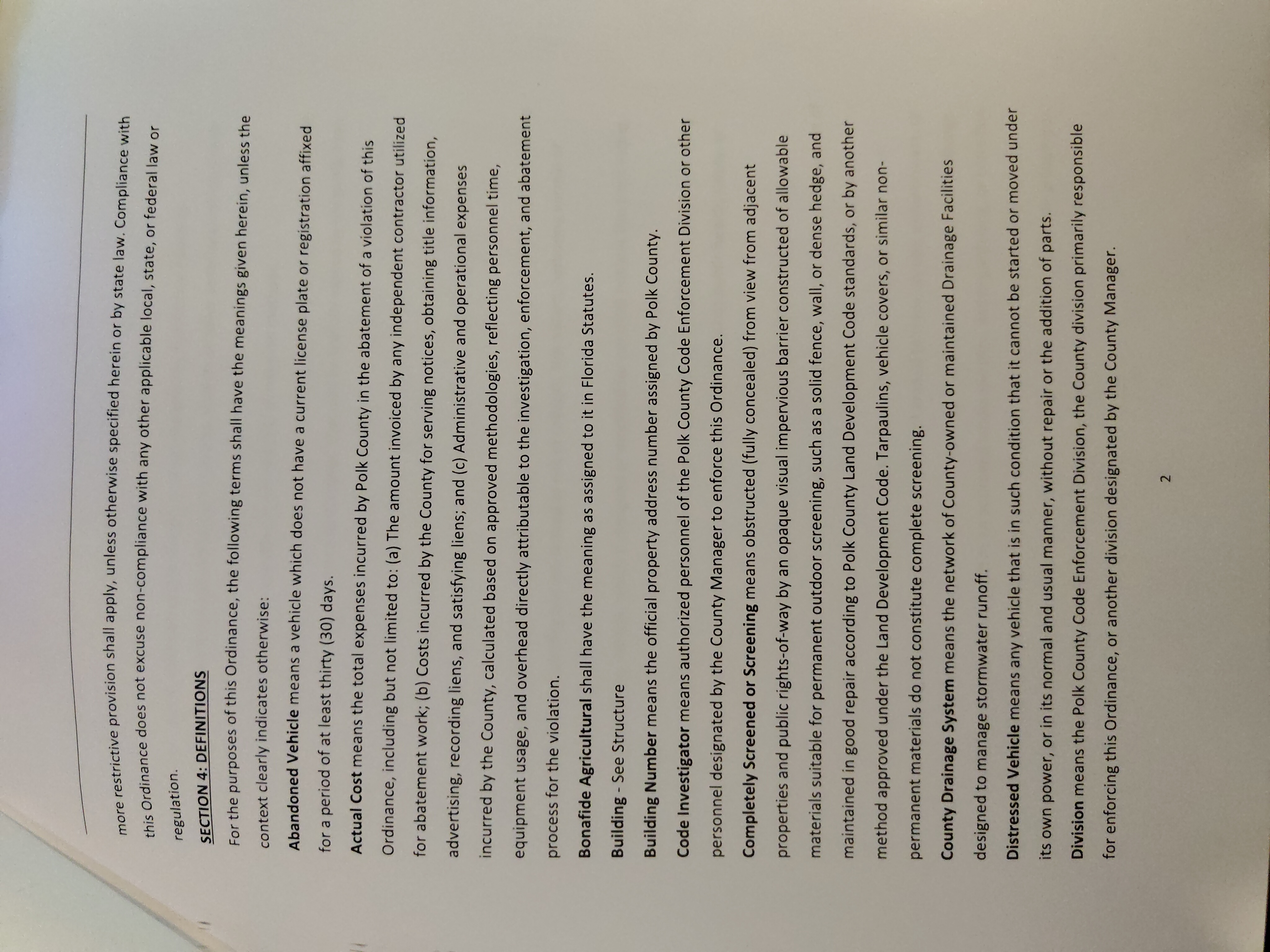
more restrictive provision shall apply, unless otherwise specified herein or by state law. Compliance with this Ordinance does not excuse non-compliance with any other applicable local, state, or federal law or regulation.

SECTION 4: DEFINITIONS

For the purposes of this Ordinance, the following terms shall have the meanings given herein, unless the context clearly indicates otherwise:

Abandoned Vehicle means a vehicle which does not have a current license plate or registration affixed for a period of at least thirty (30) days.

Actual Cost means the total expenses incurred by Polk County in the abatement of a violation of this Ordinance, including but not to: (a) The amount avoided by any independent contractor utilized for abatement work, (b) Costs incurred by the County for serving notices, obtaining file information, advertising, recording liens, and satisfying liens; and (c) Administrative and operational expenses incurred by the County, calculated based on approved methodologies, reflecting pertinent time, equipment usage, and overhead directly attributable to the investigation, enforcement, and abatement process for the violation.

Bonafide Agricultural shall have the meaning as assigned to it in Florida Statutes.

Building - See Structure

Building Number means the official property address number assigned by Polk County.

Code Investigator means authorized personnel of the Polk County Code Enforcement Division or other personnel designated by the County Manager to enforce this Ordinance.

Completely Screened means obstructed (fully concealed) from view from adjacent properties and public rights-of-way by an opaque visual barrier constructed of allowable materials for permanent outdoor screening, such as a solid fence, wall, or hedge, and maintained in good repair according to Polk County Land Development Code standards, or by any other method approved under the Land Development Code. Tarpaulins, vehicle covers, or similar non-permanent materials do not constitute complete screening.

County Drainage System means the network of County-owned or maintained Drainage Facilities designed to manage stormwater runoff.

Distressed Vehicle means any vehicle that is in such condition that it cannot be started or moved under its own power, or in its normal and usual manner, without repair or the addition of parts.

Division means the Polk County Code Enforcement Division, the County division primarily responsible for enforcing this Ordinance, or another division designated by the County Manager.

2

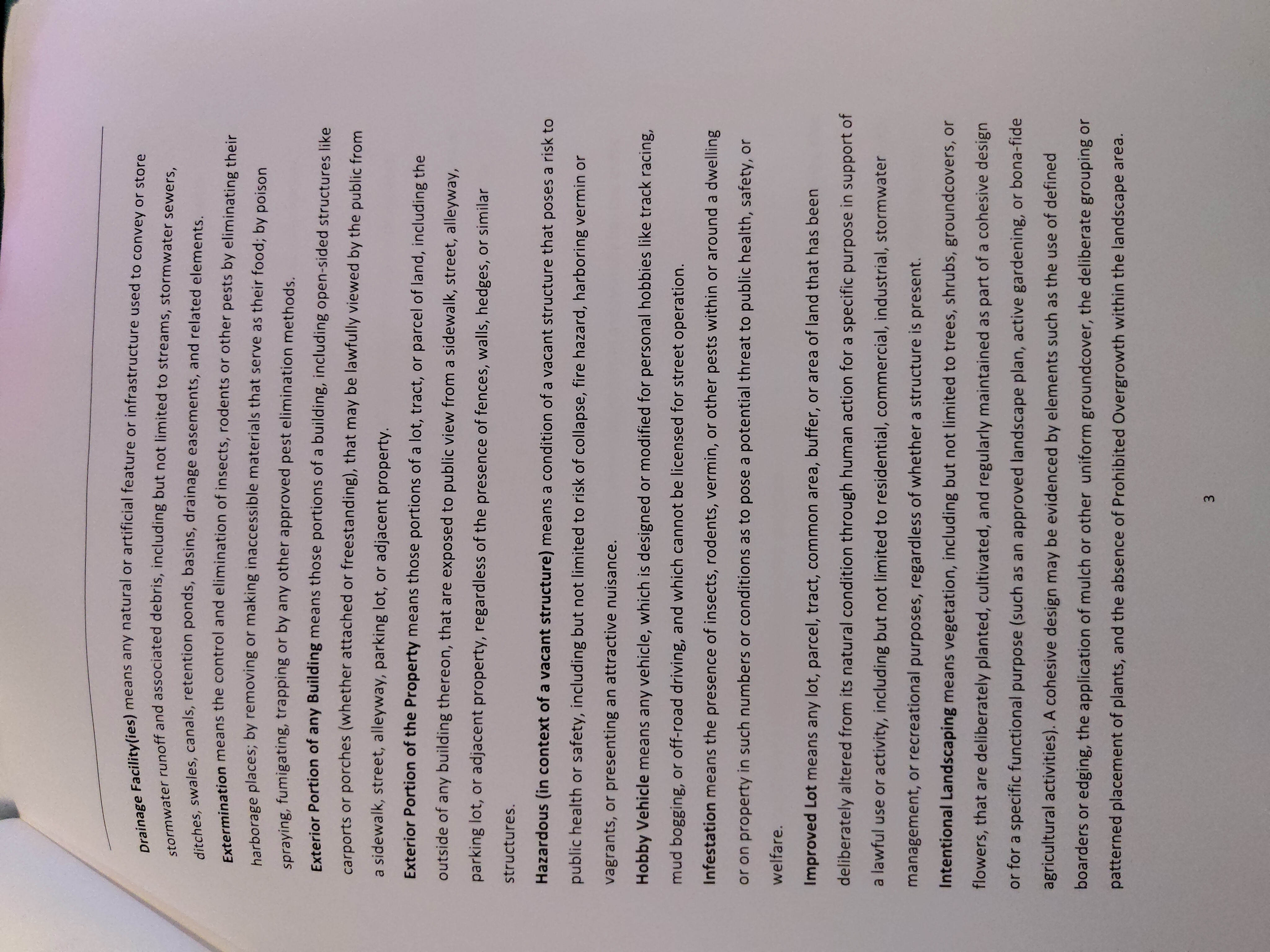
...the control and elimination of insects, rodents or other pests by eliminating their

harborage places, by removing or making inaccessible materials that serve as their food, by poison

spraying, fumigating, trapping, or by any other approved pest elimination methods.

Drainage Facility means any natural or artificial feature or infrastructure used to convey or store

stormwater culvert and associated debris, including but not limited to inlets, stormwater sewers,

ditches, swales, canals, retention ponds, basins, drainage easements, and related elements.

Exterior Portion of Any Building means those portions of a building, including open-sided structures like

carports or porches attached or freestanding), that may be lawful viewed by the public from

a sidewalk, street, alleyway, parking lot, or adjacent property.

Exterior Portion of the Property means those portions of a lot, tract, or parcel of land, including the

outside of any building thereon, that are exposed to public view from a sidewalk, street, alleyway,

parking lot, or adjacent property, regardless of the presence of fences, walls, hedges, or similar

structures.

Hazardous (in context of a vacant structure) means a condition of a vacant structure that poses a risk to

public health or safety, including but not limited to collapse, fire hazard, harboring vermin or

vagrants, or presenting an attractive nuisance.

Hobby Vehicle means any vehicle, which is designed or modified for personal hobbies like track

racing, mud bugging, or off-road driving, and which cannot be licensed for street operation.

Infestation means the presence of insects, rodents, vermin or other pests within or around a dwelling

or on property in such numbers or conditions as to pose a potential threat to public health, safety, or

welfare.

Improved Lot means any lot, tract, common area, buffer, or area of land that has been

deliberately altered from its natural condition through action for a specific purpose in support of

a lawful use or activity, including but not limited to residential, commercial, industrial, stormwater

management, or recreational purposes, regardless of whether a structure is present.

Intentional landscaping means vegetation, including but not limited to trees, shrubs, groundcovers, or

flowers, that are deliberately planted, cultivated, and regularly maintained as part of a cohesive design

or for a specific functional purpose (such as an approved landscape plan, gardening, or bona-fide

agricultural activities). A cohesive design may be evidenced by elements such as the use of defined

borders or edging, the application of mulch or other uniform groundcover, the deliberate grouping or

patterned placement of plants, and the absence of prohibited Overgrowth within the landscape area.

3

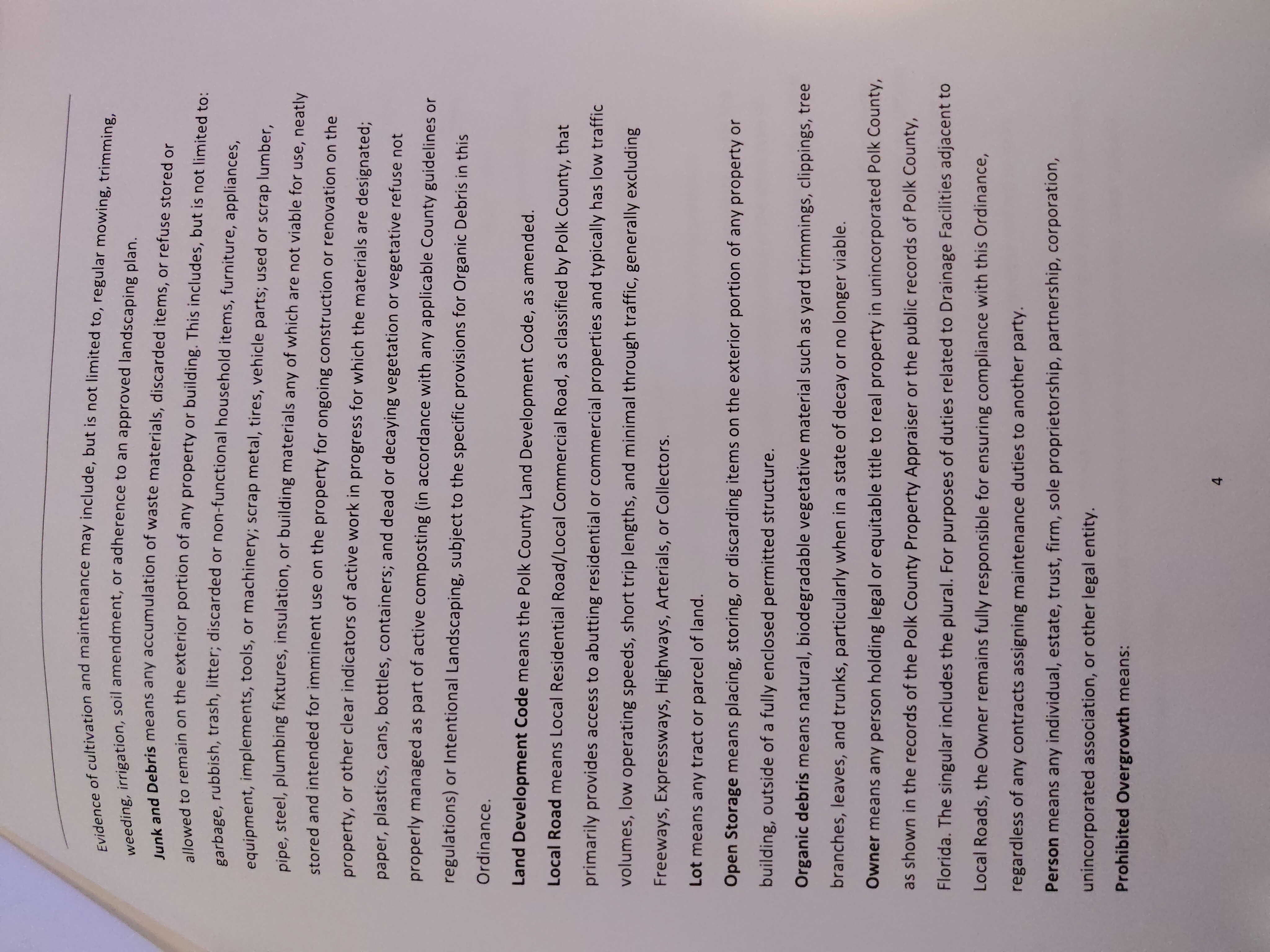
evidence of cultivation and maintenance may include, but is not limited to, regular mowing, trimming, weeding, irrigation, soil amendment, or adherence to an approved landscaping plan.

Junk and Debris means any accumulation of waste materials, discarded items, or refuse stored or allowed to remain on the exterior portion of any property or any building. This includes, but is not limited to: garbage, rubbish, trash, litter, discarded or non-functional household items, furniture, appliances, equipment, implements, tools, or machinery; scrap metal, tires, vehicle parts; use of scrap lumber, pipe, steel, plumbing fixtures, insulation, or building materials of any which are not viable for use, nearly stored and intended for imminent use on the property for ongoing construction or renovation on the property, or other clear indicators of active work in progress for which the materials are designated, paper, plastics, cans, bottles, containers; and dead or decaying vegetation or vegetative refuse not properly managed as part of active composting (in accordance with any applicable County guidelines or regulations) or Intentional landscaping, subject to the specific provisions for Organic Debris in this Ordinance.

Land Development Code means the Polk County Land Development Code, as amended.

Local Road means Residential/Local Commercial Road, as classified by Polk …… County, that primarily provides access to abutting residential or commercial properties and typically has low traffic volumes, low operating speeds, short trip lengths, and minimal through traffic, generally excluding Freeways, Expressways, Highways, Arterials, or Collectors.

Lot means any tract or parcel of land.

Open Storage means placing, storing, or discarding items on the exterior portion of any property or building, outside of a fully enclosed permitted structure.

Organic debris means natural, biodegradable vegetative material such as yard trtrimmings, clippings, tree branches, leaves, and trimmings, particularly when in a state of decay or no longer viable.

Owner means any person holding legal or equitable title to real property in unincorporated Polk County, as shown in the records of the Polk County Property Appraiser or the public records of Polk County, Florida. The singular includes the plural. For purposes of duties related to Drainage Facilities adjacent to Local Roads, the Owner remains fully responsible for ensuring compliance with this Ordinance, regardless of any contracts assigning maintenance duties to another party.

Person means any individual, estate, trust, firm, sole proprietorship, partnership, corporation, unincorporated association, or other legal entity.

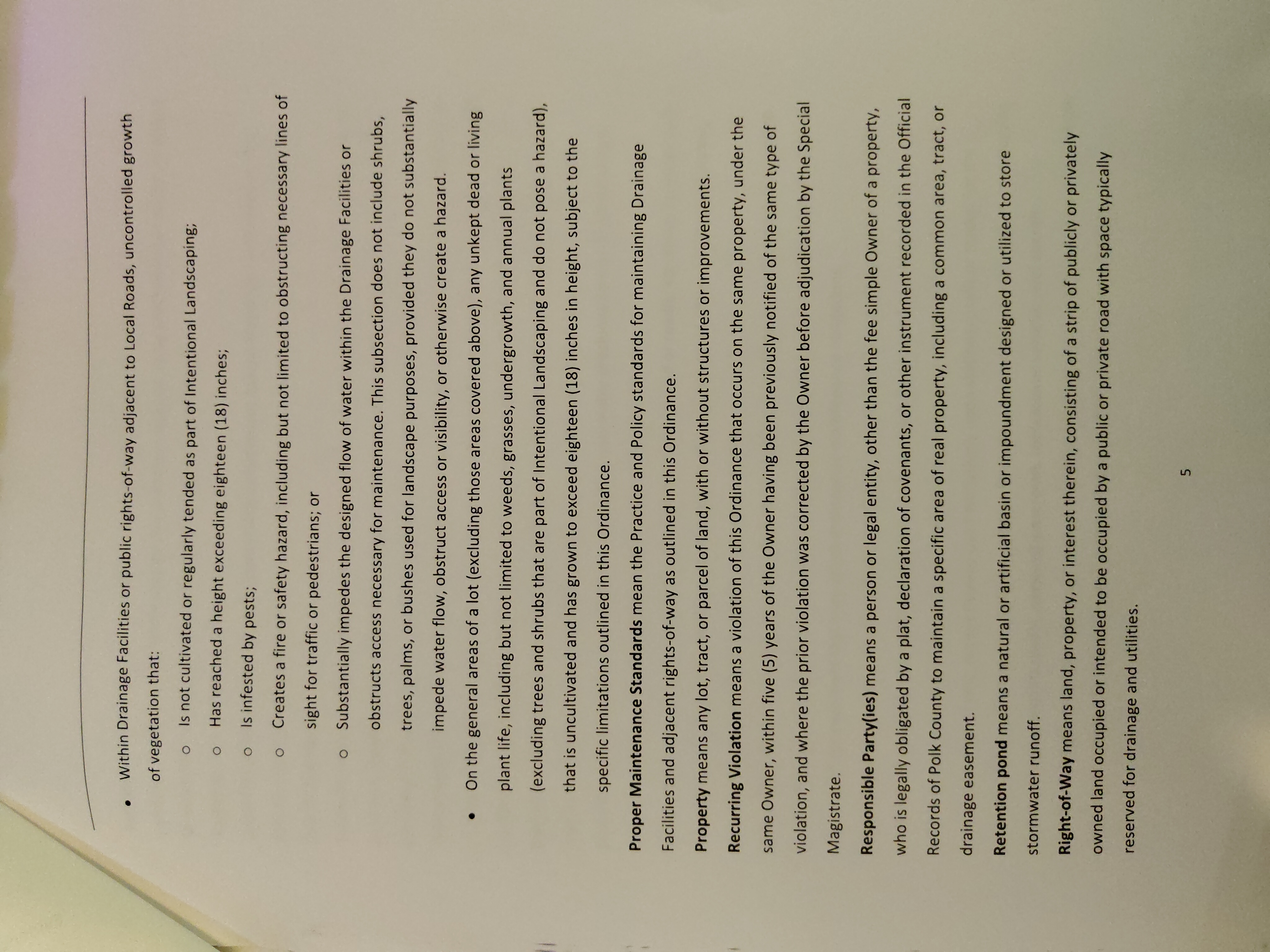
Prohibited Overgrowth means:

4

Within Drainage Facilities or public rights-of-way adjacent to Local Roads, uncontrolled growth of vegetation that:

is not cultivated or regularly tended as part of Intentionall Landscaping;

Has reached a height exceeding eighteen (18) inches;

Is infested by pests;

Creates a fire or safety hazard, including but not limited to obstructing necessary lines of sight for traffic or pedestrians; or

Substantially impedes the flow of water within the Drainage Facilities or obstructs access necessary for maintenance. This subsection does not include shrubs, trees, plants, or bushes used for landscape purposes, provided they do not substantially impede water flow, obstruct access, or otherwise create a hazard.

On the general areas of a lot (excluding those areas covered by), an upkeep deal or living plant life, including but not limited to weeds, grasses, underground, and annual plants (excluding trees and shrubs that are part of Intentional landscaping and do not pose a hazard), subject to the specific limitations outlined in this Ordinance.

Proper Maintenance Standards means the Practice and Policy standards for maintaining Drainage Facilities and adjacent rights-of-way as outlined in this Ordinance.

Property means any lot, tract, or parcel of land, with or without structures or improvements.

Recurring Violation means a violation of this Ordinance that occurs on the same property, under the same Owner, within five (5) years of the Owner having been previously notified of the same type of violation, and where the prior violation was corrected by the Owner before adjudication by the Special Magistrate.

Responsible Party(ies) means a person or legal entity, other than the fee simple Owner of a property, who is legally obligated by a plat, declaration of covenants, or other instrument recorded in the Official Records of Polk County to maintain a specific area of real property, including a common area, tract, or drainage easement.

Retention pond means a natural or artificial basin or impoundment designed or utilized to store stormwater runoff.

Right-of-Way means land, or property, that is even, consisting of a strip of publicly or privately owned land occupied or intended to be occupied by a public or private road with space typically reserved for drainage and utilities.

5

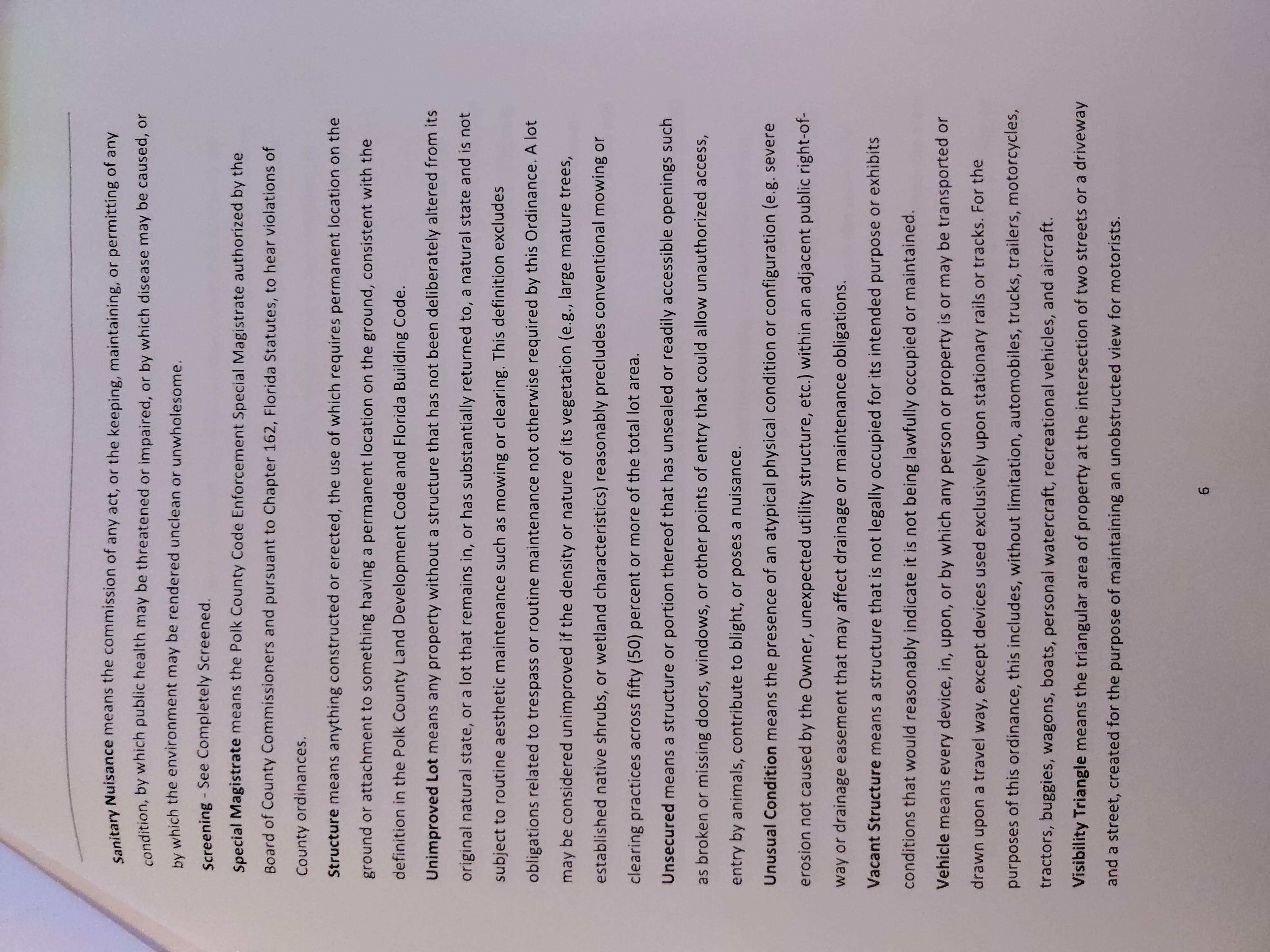
Sanitary Nuisance means the commission of any act, or the keeping, maintaining, or permitting of any condition, by which public health may be threatened or impaired, or by which disease may be caused, or by which the environment may be rendered unclean or unwholesome.

Screening — See: Completely Screened.

Special Magistrate means the Polk County Code Enforcement Special Magistrate authorized by the Board of County Commissioners and pursuant to Chapter 162, Florida Statutes, to hear violations of County ordinances.

Structure means anything constructed or erected, the use of which requires permanent location on the ground or attachment to something having a permanent location on the ground, consistent with the definition in the Polk County Land Development Code and Florida Building Code.

Unimproved Lot means any property without a structure that has not been deliberately altered from its original natural state, or a lot, that remains in, or has substantially remains otherwise by this Ordinance. This obligation related to trespass or routine maintenance such as mowing or clearing. This definition excludes

Unsecured means a structure or portion thereof that has unsealed or readily accessible openings such as broken doors, windows, or other points of entry that could allow unauthorized access, by animals, disturbs to blight, or poses a nuisance.

Unusual Condition means the presence of an atypical physical condition or configuration (e.g. severe erosion not caused by the Owner, unexpected utility structure, etc.) within an adjacent public right-of-way or drainage easement that may affect drainage or maintenance obligations.

Vacant Structure means a structure that is not legally occupied for its intended purpose or exhibits conditions that would reasonably indicate it is not being lawfully occupied or maintained.

Vehicle means every device, in upon, or upon which any person or property is or may be transported or drawn upon a travel way, except devices used exclusively upon stationary rails or tracks. For the purposes of this ordinance, this includes, without limitation, automobiles, trucks, trailers, motorcycles, tractors, buggies, wagons, boats, watercraft, recreational vehicles, and aircraft.

Visibility Triangle means the triangular area of property at the intersection of two streets or a driveway and a street, created for the purpose of maintaining an unobstructed view for motorists.

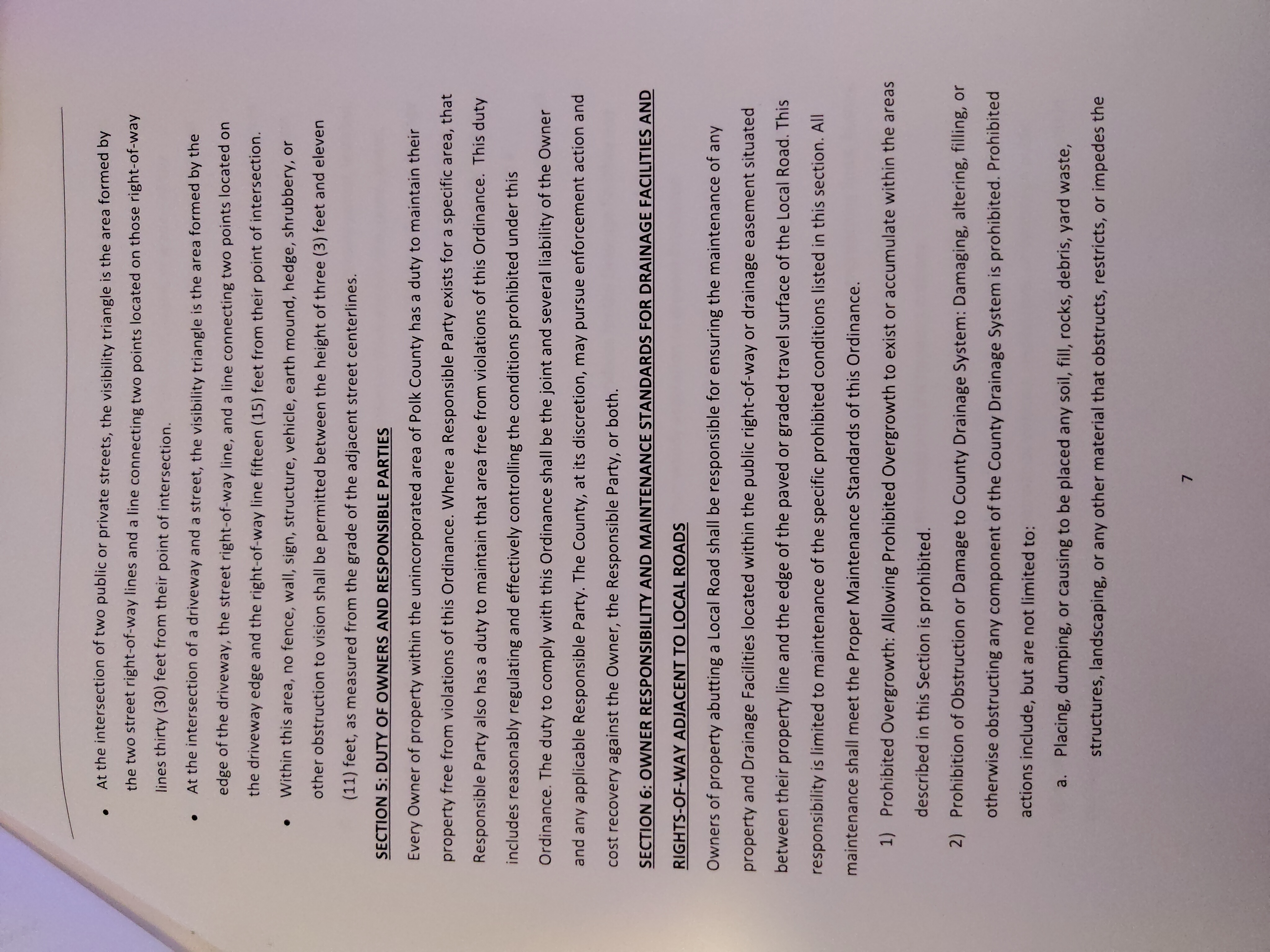
 At the intersection of two public or private streets, the visibility triangle is the area formed by the two street right-of-ways and a line connecting two points located on those right-of-way lines thirty (30) feet from their point of intersection.

At the intersection of a driveway and a street, the visibility triangle is the area formed by the edge of the driveway, the street right-of-way, and a line connecting two points located on the driveway edge and the right-of-way line fifteen (15) feet from their point of intersection.

    Within this area, no fence, wall, sign, structure, vehicle, earth mound, hedge, shrubbery, or other obstruction to vision shall be permitted between the height of three (3) feet and eleven (11) feet, as measured from the grade of the adjacent street centerlines.

SECTION 5: DUTY OF OWNERS AND RESPONSIBLE PARTIES

Every Owner of property within the unincorporated area of Polk County has a duty to maintain their property free from violations of this Ordinance. Where a Responsible Party exists for a specific area, that Responsible …… Party also has a duty to maintain that area from violations of this Ordinance. This duty includes reasonably regulating and effectively controlling the conditions prohibited under this Ordinance. The County, at its discretion, may pursue enforcement action and cost recovery against the Owner, the Responsible Party, or both.

SECTION 6: OWNER RESPONSIBILITY AND MAINTENANCE STANDARDS FOR DRAINAGE FACILITIES AND RIGHTS-OF-WAY ADJACENT TO LOCAL ROADS

Owners of property abutting a Local Road shall be responsible for ensuring the maintenance of any property and Drainage Facilities located within the public right-of-way or drainage easements situated between their property line and the edge of the paved or graded travel surface of the Local Road. This responsibility is limited to maintenance of the specific prohibited conditions listed in this section. All maintenance shall meet the Proper Maintenance Standards of this Ordinance.

1) Prohibited Overgrowth: Allowing Prohibited Overgrowth to exist or accumulate within the areas described in this Section is prohibited.

2) Prohibition of Obstruction or Damage to County Drainage System: Damaging, altering, filling, or otherwise obstructing any component of the County Drainage System is prohibited. Prohibited actions include, but are not limited to:

a. Placing, dumping, or causing to be placed any soil, fills, rocks, debris, yard waste;

7

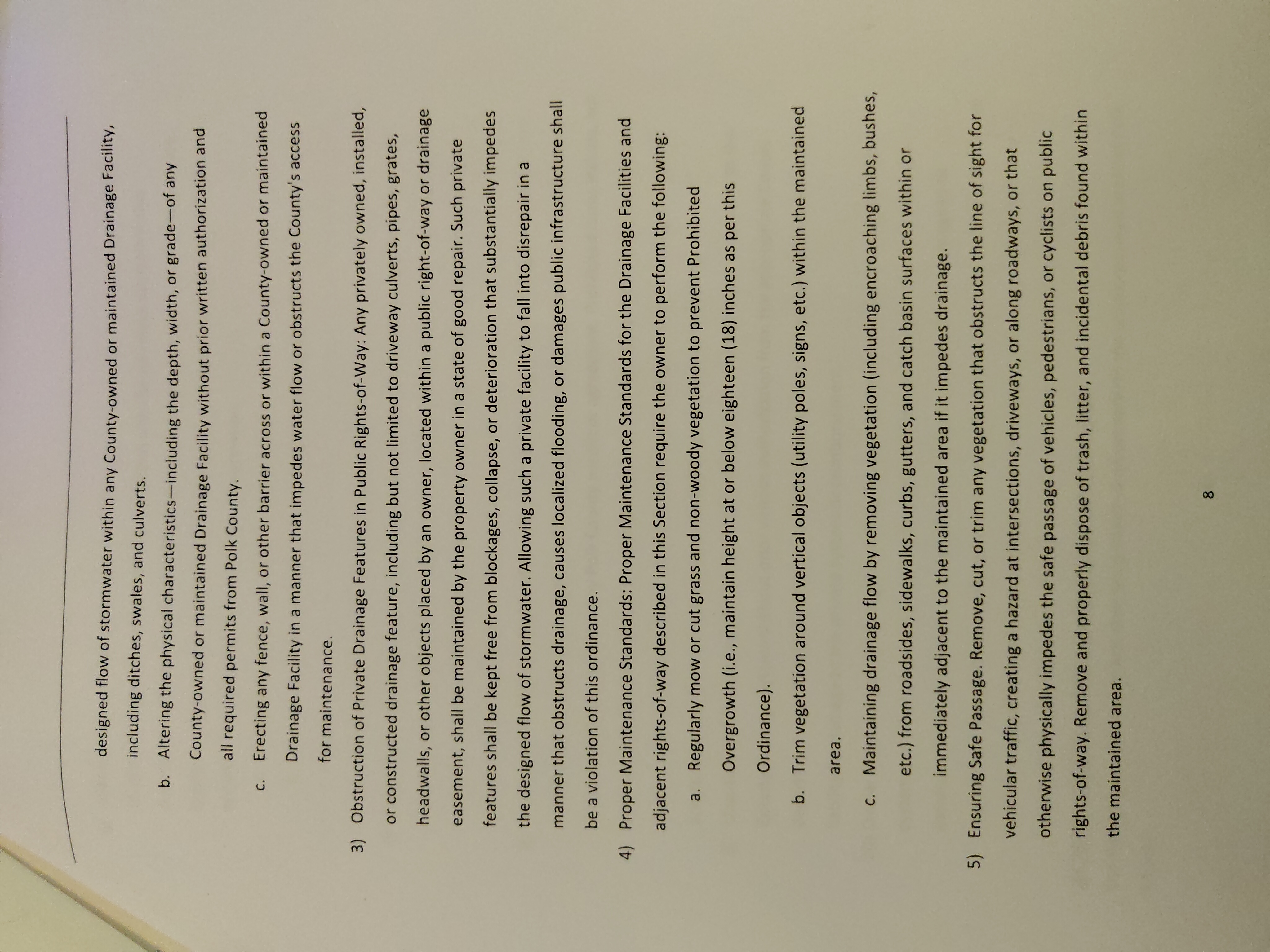
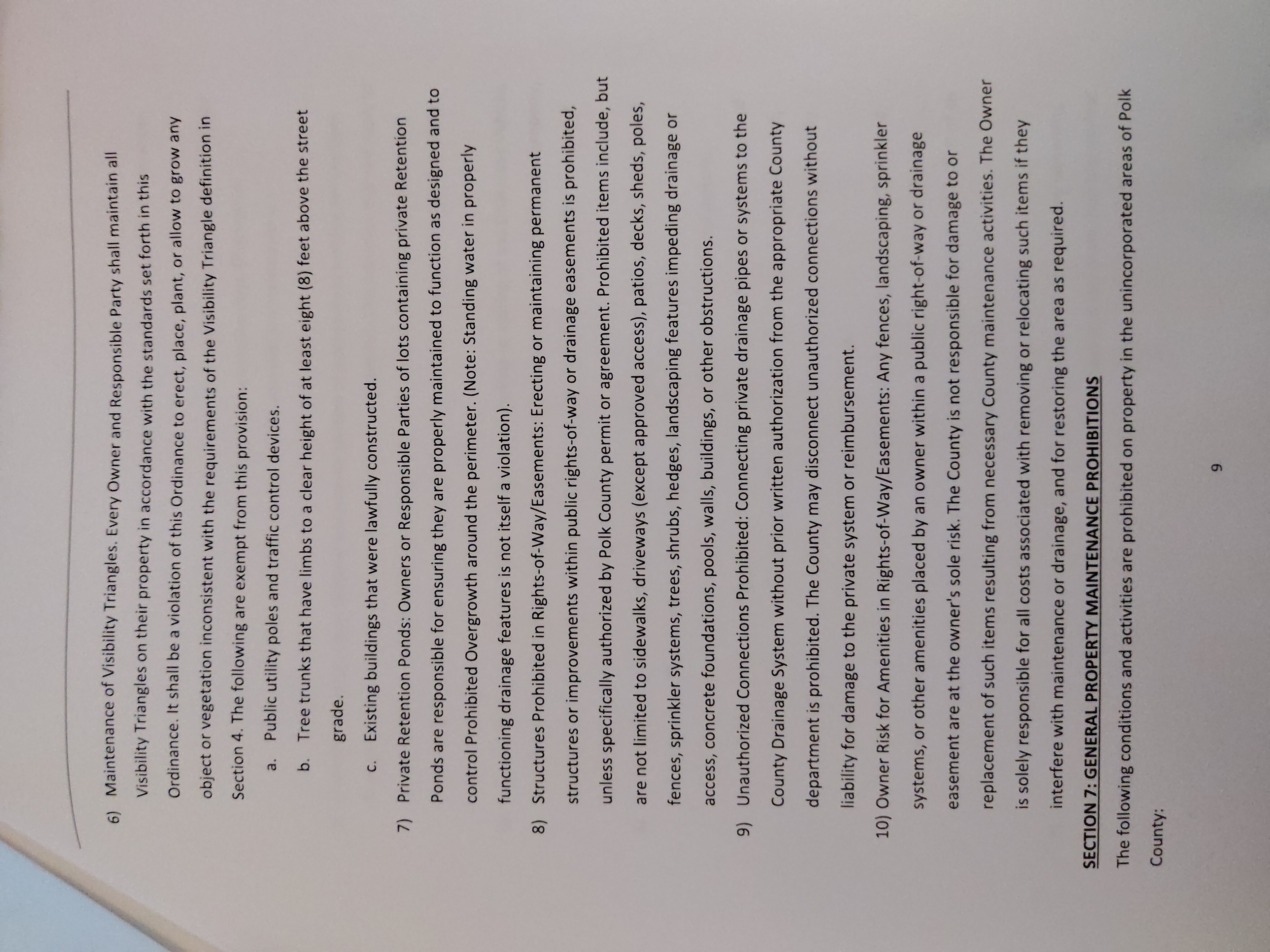
...designed flow of stormwater within any County-owned or maintained Drainage Facility, including ditches, swales, and culverts.

b. Altering the physical characteristics—including the depth, width, …… or grades—of any County-owned or maintained Drainage Facility without prior written authorization and all required permits from Polk County.

c. Erecting any fence, wall, or barrier across or within a County-owned or maintained Drainage Facility in a manner that impedes water flows or obstructs the County's access for maintenance.

3) Obstruction of Private Drainage Features in Public Rights-of-Way. Any privately owned, installed, or constructed drainage feature, including but not limited to culverts, pipes, grates, headwalls, or other objects placed by an owner, located within a public right-ofway or drainage easement, shall be maintained by the property owner in a state of good repair. Such private features shall be kept free from blockages, collapse, or deterioration that substantially impedes the designed flow of stormwater. Allowing such a private facility to fall into disrepair in a manner that obstructs drainage, causes flooding, or damages public infrastructure shall be a violation of this ordinance.

4) Proper Maintenance Standards: Proper Maintenance Standards for the Drainage Facilities and adjacent rights-of-way as outlined in this Section require the owner to perform the following:

a. Regularly mow or cut grass and non-woody vegetation to prevent Prohibited Overgrowth (i.e., maintain height at or below eighteen (18) inches as this Ordinance).

b. Trim vegetation around vertical objects (utility poles, signs, etc.) within the maintained area.

c. Maintaining drainage flow by removing vegetation (including encroaching limbs, bushes, etc.) from roadsides, sidewalks, curbs, gutters, and catch basin surfaces within or immediately adjacent to the maintained area if it impedes

6) Maintenance of Visibility Triangles. Every Owner and Responsible Party shall maintain all

Visibility Triangles on their property in accordance with the standards set forth in this

Ordinance. It shall be a violation of this Ordinance to erect, place, plant, or allow to grow any

object or vegetation inconsistent with the requirements of the Visibility Triangle definition in

Section 4. The following are exempt from this provision:

a. Public utility poles and traffic control devices.

b. Tree trunks that have limbs to a clear height of at least eight (8) feet above the street grade.

c. Existing buildings that were lawfully constructed.

7) Private Retention Ponds: Owners or Responsible Parties of lots containing private Retention

Ponds are responsible for ensuring they are properly maintained to function as designed and to

control Prohibited Overgrowth around the perimeters. (Note: Standing water in properly

functioning drainage features is not a violation.)

8) Structures Prohibited in Rights-of-Way/Easements: Streets or pavement improvements within public rights-of-way or drainage easements is prohibited, but unless specifically authorized by Polk County permit or agreement. Prohibited items include, but are not limited to sidewalks, driveways (except approved access), patios, decks, sheds, poles fences, sprinkler systems, trees, shrubs, hedges, landscaping features impeding drainage or access, concrete foundations, pools, walls, buildings, or other obstructions.

9) Unauthorized Connections: Connecting private drainage pipes or systems to the

County Drainage System without prior authorization from the appropriate County

department is prohibited. The County may disconnnect unauthorized connections without

liability for damage to the private system or reimbursement

10) Owner Risk for Amenities in Rights of Way/Easements: Any fences, landscaping, sprinkler

systems, or other amenities placed by an owner within a public right-of way or drainage

easement are at the owner's sole risk. The County is not responsible for damage to or

replacement of such items resulting from removing or relocating such items if they

interferes with maintenance or drainage, and for restoring the area as required.

SECTION 7: GENERAL PROPERTY MAINTENANCE PROHIBITIONS

The following conditions and activities are prohibited on property in the unincorporated areas of Polk County:

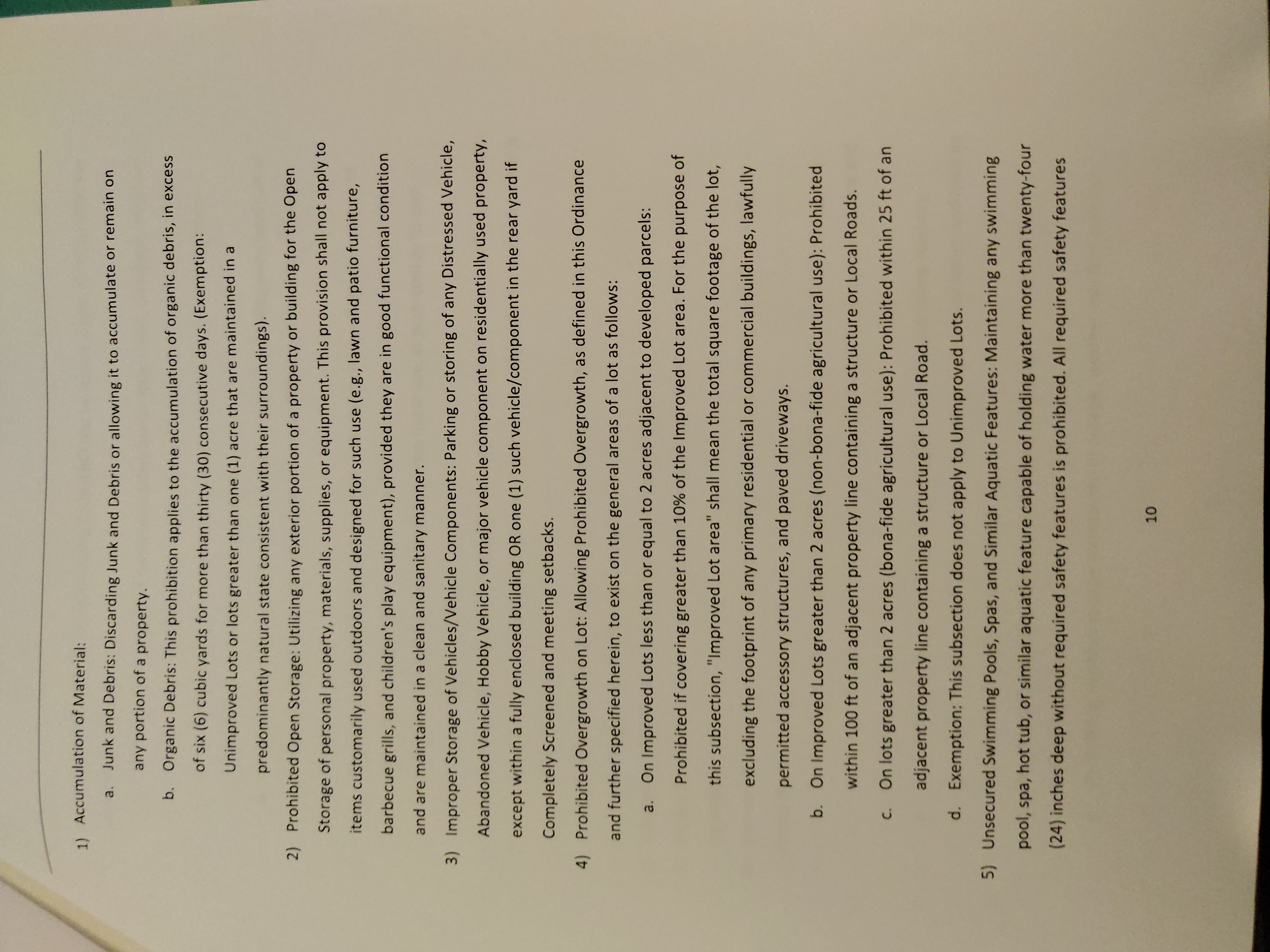
1) Accumulation of Material:

a) Junk and Debris: Discarding Junk and Debris or allowing it to accumulate or remain on any portion of a property.

b) Organic Debris: This prohibition applies to the accumulation of organic debris, in excess of six (6) cubic yards for more than thirty (30) consecutive days. (Exemption: Unimproved Lots or lots greater than one (1) acre that are maintained in a

2) Prohibited Open Storage: Utilizing any exterior portion of a property or building for the Open Storage of personal property, materials, supplies, or equipment. This provision shall not apply to items customarily used and designed for such use (e.g., lawn and patio furniture, barbeque grills, and children's play equipment), provided they are in good functional condition and are maintained in a clean and sanitary manner.

3) Improper Storage of Vehicles/Vehicle Components: Parking or storing of any Distressed Vehicle, Abandoned Vehicle, Hobby Vehicle, or any vehicle component on residentially used property, except within a fully enclosed building or one (1) such vehicle/component in the rear yard if Completely Screened and meeting setbacks.

4) Prohibited Overgrowth on Lot: Allowing Prohibited Overgrowth, as defined in this Ordinance [...] as follows:

a. On Improved Lots less than or equal to 2 acres adjacent to developed parcels:

[Unreadable text]... For the purpose of this subsection, "Improved Lot Area" shall mean the total Square footage of the …… [unreadable]... excluding the footprint of any residential or commercial buildings, lawfully permitted accessories structures, and paved driveways.

b. On Improved Lots greater than 2 acres (non-bona-fide agricultural use): Prohibited within 100 ft100 ft of an adjacent property line containing a structure or Local Roads.

c. On lots greater than 2 [acres] (non-bona-fide agricultural use): Prohibited within 25 ft25 ft of an adjacent property line containing a structure or Local Roads.

a. On Improved Lots less than or equal to 2 acres adjacent to developed parcels:

Prohibited if covering greater than 10% of the Improved Lot area. For the

purpose of this subsection, "Improved Lot area" shall mean the total square footage of the lot,

excluding the footprint of any primary residential or commercial buildings, lawfully

permitted accessory structures, and paved driveways.

b. On Improved Lots greater than 2 acres (non-bona-fide agricultural use): Prohibited

within 100 ft of an adjacent property line containing a structure or Local Roads.

c. On lots greater than 2 acres (bona-fide agricultural use): Prohibited within 25 ft of an

adjacent property line containing a structure or Local Road.

d. Exemption: This subsection does not apply to Unimproved Lots.

5) Unsecured Swimming Pools, Spas, and Similar Aquatic Features: Maintaining any swimming

pool, spa, hot tub, or similar aquatic feature capable of holding water more than twenty-four

(24) inches deep without required safety features is prohibited. All required safety features

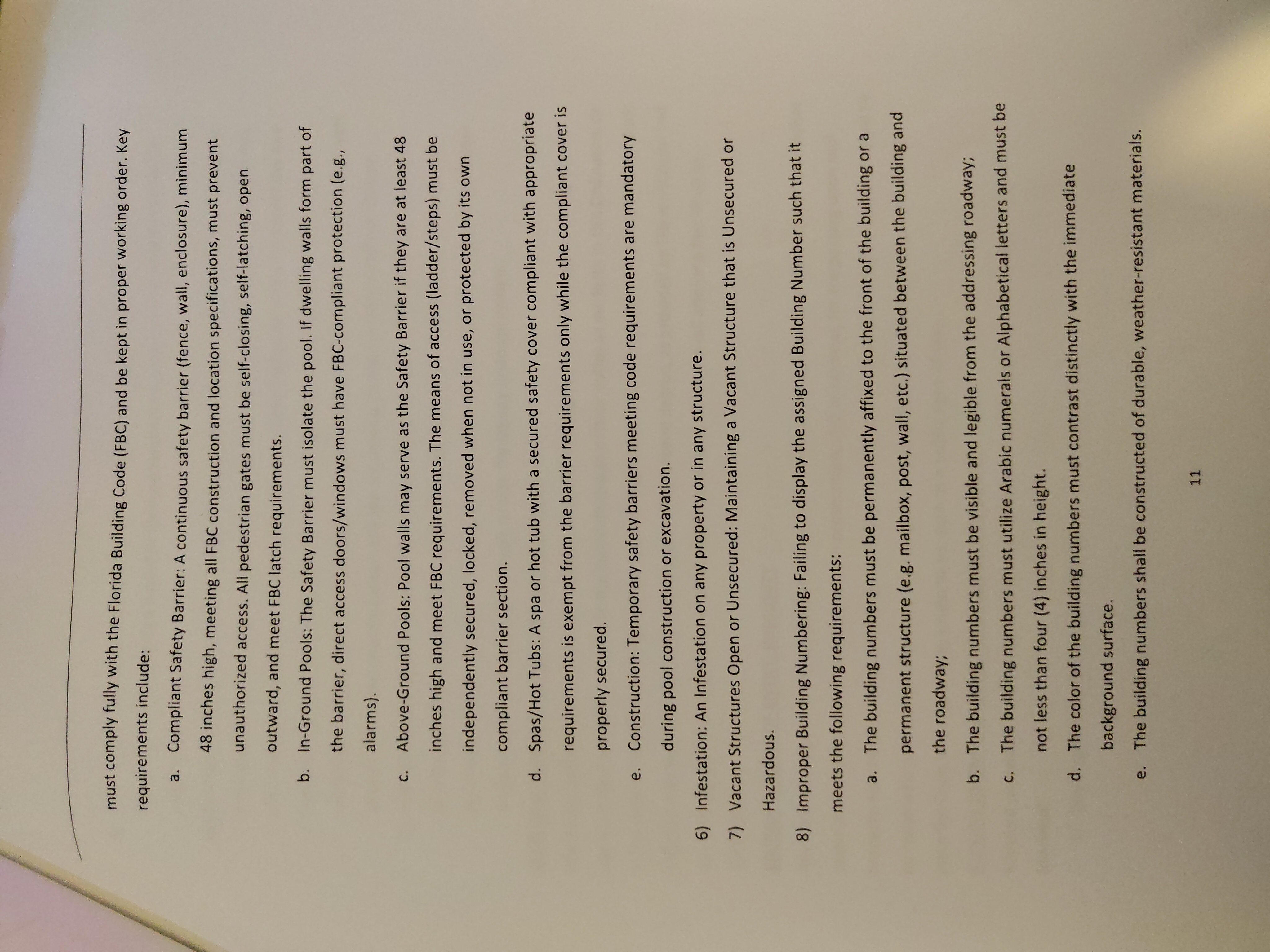
10

...must comply fully with the Florida Building Code (FBC) and be kept in proper working order. Key requirements includes:

a. Compliant Safety Barrier: A continuous safety barrier (fence, wall, enclosure) minimum 48 inches high, meeting all FBC construction and location specifications, must prevent unauthorized access. All pedestrian gates must be self-latching, self-locking, open outward, and meet FBC latch requirements.

b. In-Ground Pools: The Safety Barrier must insulate the pool. If dwelling walls form part of the barrier, direct access doors/windows must have FBC-compliant protection (e.g., alarms).

c. Above-Ground Pools: Pool walls may serve as the Safety Barrier if they are at least 48 inches high and meet FBC requirements. The means of access (ladder/steps) must be independently secured, locked, removed when in use, or protected by its own compliant barrier section.

d. Spas/Hot Tubs: A spa or hot tub with a secured safety cover compliant with appropriate requirement is exempt from the barrier requirements only while the compliant cover is properly secured.

e. Construction: Temporary safety barriers meeting code requirements are mandatory during pool construction or excavation.

5) Infestation: An infestation on any property or in any structure.

7) Vacant Structures Open or Unsecured: Maintaining a Vacant Structure that is Unsecured or Hazardous

8) Improper Building Numbering: Failing to display the assigned Building Number such that it meets the following requirements:

a. The building numbers must be permanently affixed to the front of the building or a permanent structure (e.g. mailbox, post, wall, etc.) situated between the building and the roadway;

b. The building numbers must be visible and legible from the addressing roadway;

c. The building numbers must utilize Arabic numerals or Alphabetical letters and must be not less than four (4) inches in height.

d. The color of the building numbers must contrast distinctly with the immediate background surface.

e. The building numbers shall be constructed of durable, weather-resistant materials.

11

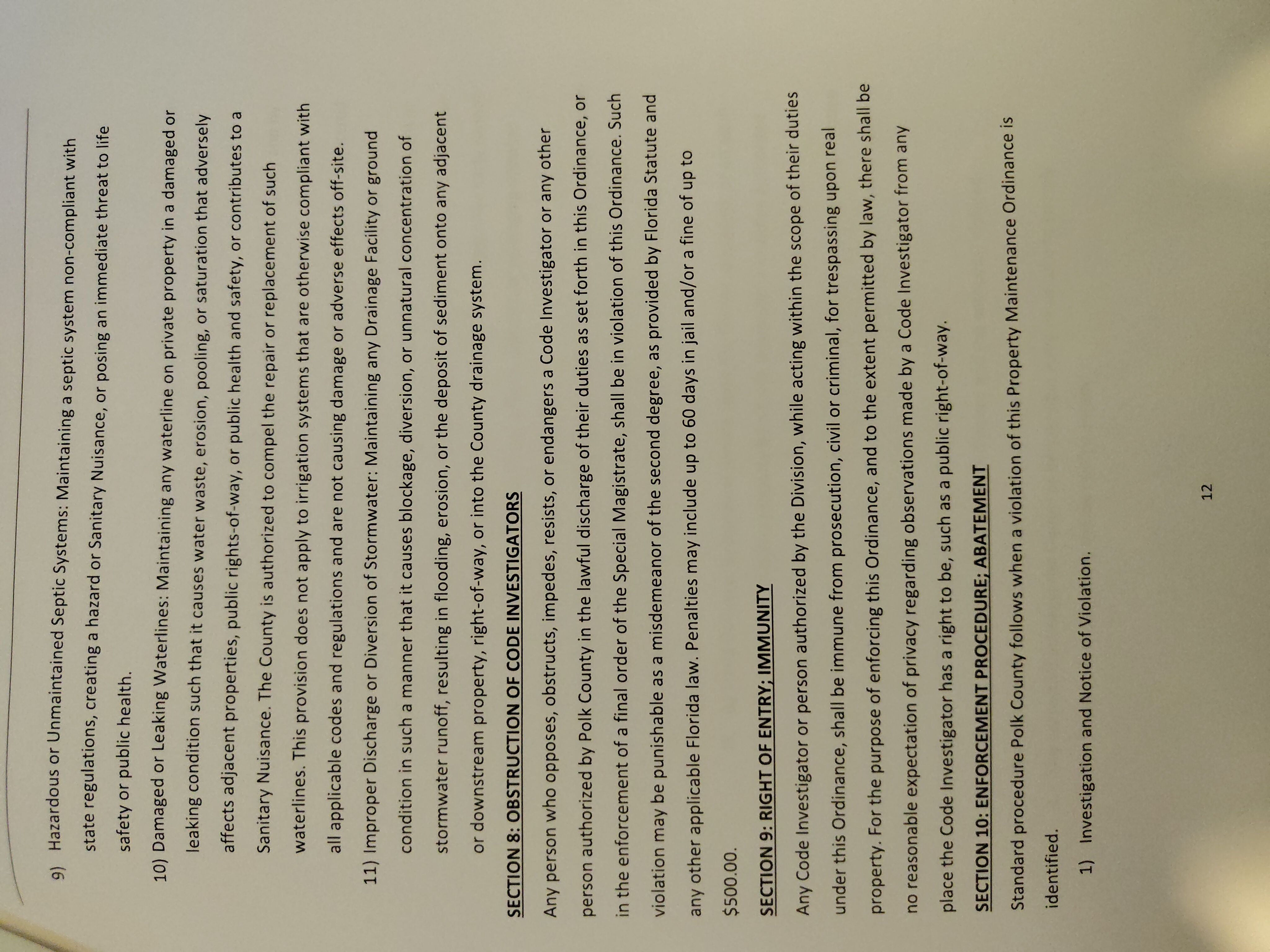
9) Hazardous or Unmaintained Septic Systems: Maintaining a septic system non-compliant with state regulations, creating a hazard or Sanitary Nuisance, or posing an immediate threat to life safety or public health.

10) Damaged or Leaking Waterlines: Maintaining any waterline on private property in a damaged or leaking condition such that it causes water, erosion, pooling, or saturation that adversely affects adjacent properties, public rights-of-way, or public health and safety, or contributes to a Sanitary Nuisance. The County is authorized to compel the repair or replacement of such waterlines. This provision does not apply to irrigation systems that are otherwise compliant with all applicable codes and regulations and that are otherwise do not cause damage or adverse effects of site.

11) Improper Drainage or Diversion of Stormwater: Maintaining any Drainage Facility or ground condition in such a manner that it causes blockage, diversion, or unnatural concentration of stormwater runoff, resulting in flooding, erosion, or the deposit of sediment onto any adjacent or downstream property, right-of-way, or into the County drainage system.

SECTION 8: OBSTRUCTION OF CODE INVESTIGATORS

Any person who opposes, obstructs, impedes, or endangers a Code Investigator or any other person authorized by Polk County in the lawful discharge of their duties as set forth in this Ordinance, or in the enforcement of an final order of the Special Magistrate, shall be in violation of this Ordinance. Such violation may be punishable as a misdemeanor of the second degree, as provided by Florida Statute and any other applicable Florida law. Penalties may include up to 60 days in jail and/or a fine of up to \500.00$.

SECTION 9: RIGHT OF ENTRY; IMMUNITY

Any Code Investigator or person authorized by the Division, while acting within the scope of their duties under this Ordinance, shall be immune from prosecution, civil or criminal, for trespassing upon real property. For the purpose of enforcing this Ordinance, and to the extentextent permitted by law, there shall be no reasonable expectation of privacy regarding observations made by a Code Investigator from any place the Code Investigator has a right to be, such as a public right-of-way.

SECTION 10: ENFORCEMENT PROCEDURE; ABATEMENT

Standard procedure Polk County follows when a violation of this Property Maintenance Ordinance is identified.

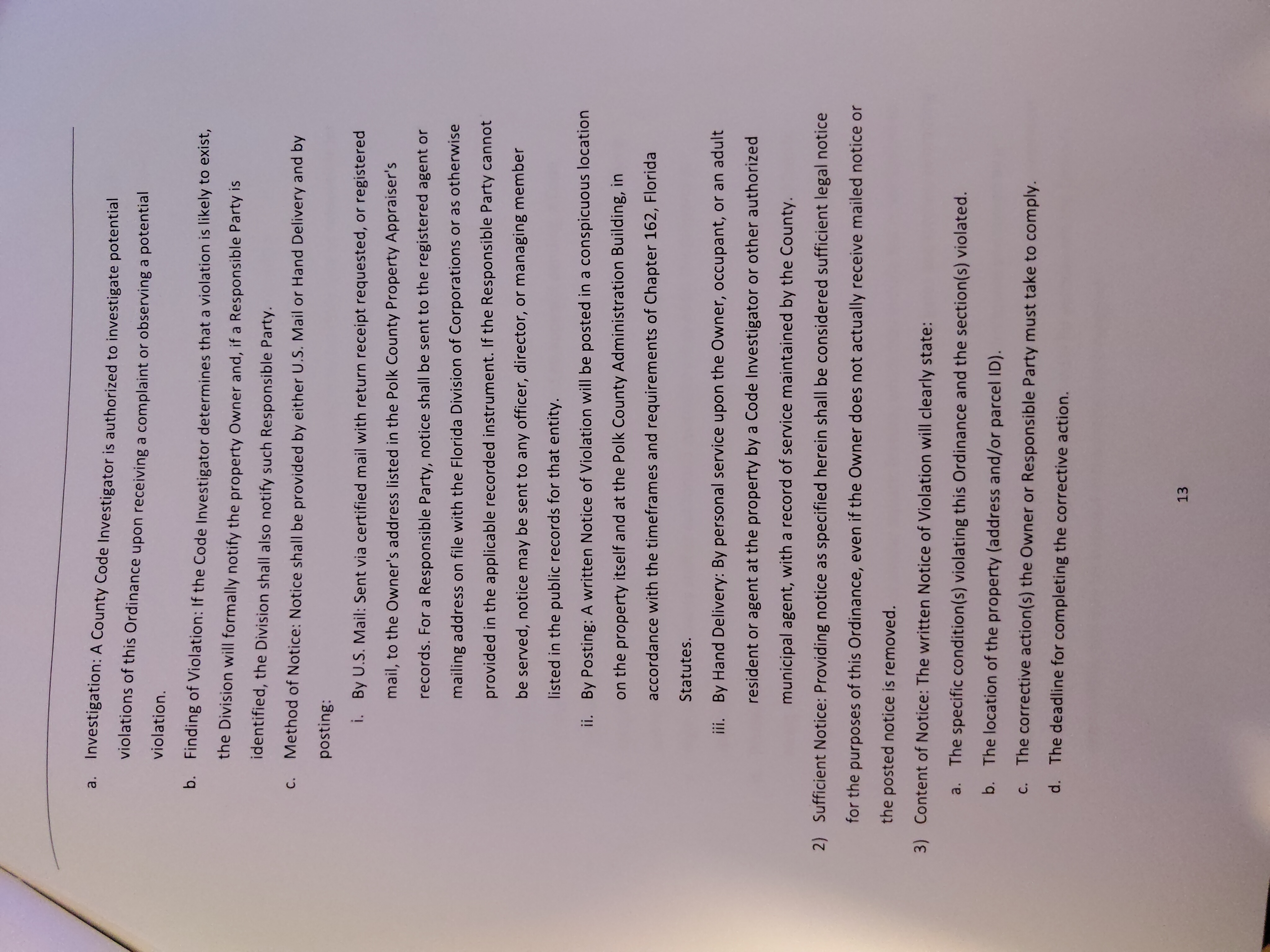
1) Investigation and Notice of Violation.

12

a. Investigation: A County Code Investigator is authorized to investigate potential violations of this Ordinance upon receiving a complaint or observing a potential violation.

b. Finding of Violation: If the Code Investigator determines that a violation is likely to exist, the Division will formally notify the property Owner, and if a Responsible Party is identified, the Division shall also notify such Responsible Party.

c. Method of Notice: Notice shall be provided by either U.S. Mail or Hand Delivery and by posting:

i. By U.S. Mail: Sent via certified mail with return receipt requested, or registered mail, to the Owner's address listed in the Polk County Property Appraiser's records. For a Responsible Party, notice shall be …… sent to the registered agent or mailing address on file with the Florida Division of Corporations or as otherwise provided in the applicable record, if the Responsible Party cannot be served, notice may be sent to any officer, director, or managing member listed in the public records for that entity.

ii. By Posting: A written Notice of Violation will be posted in a conspicuous location on the property itself and the Polk County Administration Building, in accordance with the timeframes and requirements of Chapter 162, Florida Statutes.

iii. By Hand Delivery: By personal service upon the Owner, occupant, or an adult resident or agent by a record of service maintained by the County.

2) Sufficient Notice: Providing notice as specified herein shall be considered sufficient legal notice for the purposes of this Ordinance, even if the Owner does not actually receive mailed notice or the posted notice is removed.

3) Content of Notice: The written Notice of Violation will clearly state:

a. The specific condition(s) violating this Ordinance and the section(s) violated.

b. The location of the property address and/or parcel ID.

c. The corrective action(s) the Owner or Responsible Party must take to comply.

d. The deadline for completing the corrective action.

13

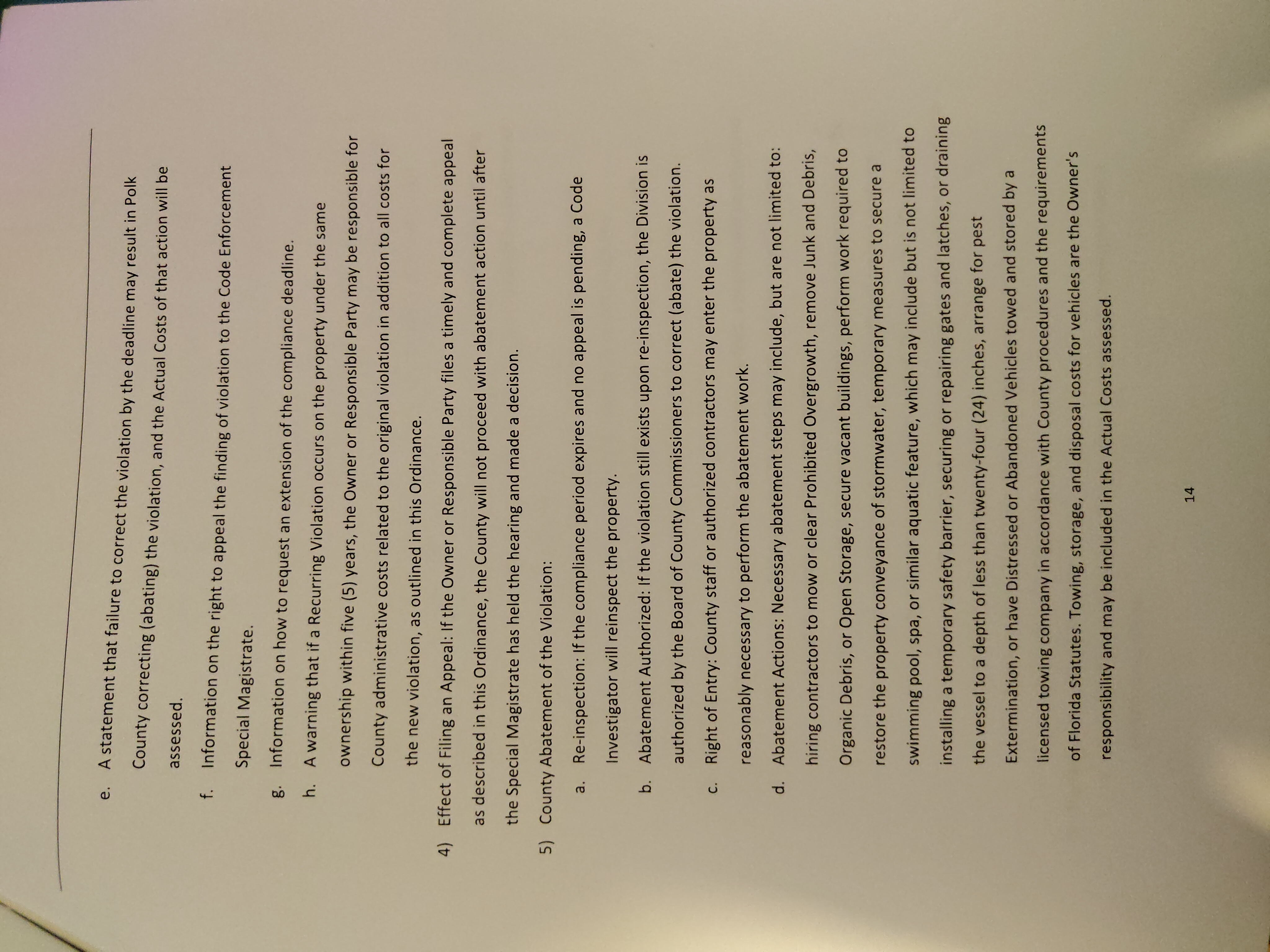
e. A statement that failure to correct the violation by the deadline may result in Polk County correcting (abating) the violation, and the Actual Costs of that action will be assessed.

f. Information on the right to appeal the finding of violation to the Code Enforcement Special Magistrate.

g. Information on how to request an extension of the compliance deadline.

h. A warning that if a Recurring Violation occurs on the property under the same County administrative costs related to the original violation in addition to all costs for the new violation, as outlined in this Ordinance.

4) Effect of Filing an Appeal: If the Owner or Responsible Party files a timely and complete appeal as described in this Ordinance, the County will not proceed with abatement action until after the Special Magistrate has held the hearinghearing and made a decision.

5) County Abatement of the Violation:

a. Re-inspection: If the compliance period expires and no appeal is pending, a Code Investigator will inspect the property.

b. Abatement Authorized: If the violation still exists upon re-inspection, the Division is authorized by the Board of County Commissioners to correct (abate) the violation.

c. Right of Entry: County staff or authorized contractors may enter the property as reasonably necessary to perform the abatement work

d. Abatement Actions: Necessary abatement steps may include, but are not limited to: hiring contractors to mow or clear Prohibited Overgrowth, remove junk and Debris, Organic Debris, or Open Storage, secure vacant buildings, perform work required to restore the property conveyance of stormwater, temporary measures to secure a swimming pool, spa, or similar aquatic feature, which may include but is not limited to installing a temporary safety barrier, repairing gates and latches, or draining exterminations, or have Distressed or Abandoned Vehicles towed and stored by a licensed towing company in accordance with County procedures and the requirements of Florida Statutes. Towing, storage, and disposal costs for vehicles are the Owner's responsibility and may be included in the Actual Costs assessed.

14

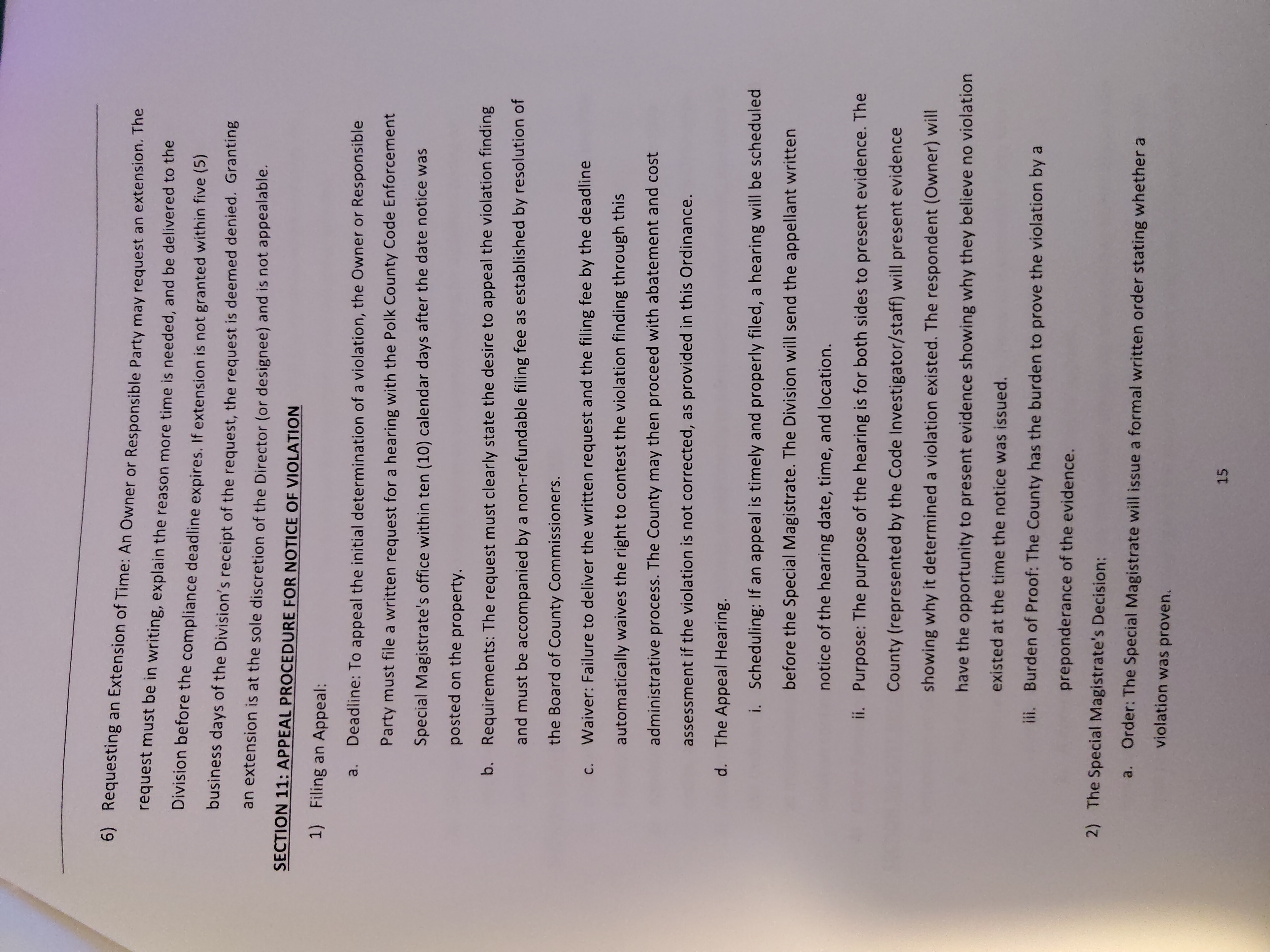
6) Requesting an Extension of Time: An Owner or Responsible Party may request an extension. The request must be in writing, explain the reason more time is neededneeded, and be delivered to the Division before the compliance deadline expires. If extension is not granted within five (5) business days of the Division's receipt of the request, the request is deemed expired. Granting an extension is at the sole discretion of the Director (or designee) and is not appealable.

SECTION 11: APPEAL PROCEDURE FOR NOTICE OF VIOLATION

1) Filing an Appeal:

a. Deadline: To appeal the initial determination of a violation, the Owner or Responsible Party must file a written request for a hearing with the Polk County Code Enforcement Special Magistrate's office within ten (10) calendar days after the date notice was posted on the property.

b. Requirements: The request must clearly state the desire to appeal the violation finding and must be accompanied by a non-refundable filing fee as established by resolution of the Board of County Commissioners.

c. Waiver: Failure to deliver the written request and the filing feefee by the deadline automatically waives the right to contest the violation finding through this administrative process. The County may then proceed with abatement and cost assessment if the violation is not corrected, as provided in this Ordinance.

d. The Appeal Hearing:

i. Scheduling: If an appeal is timely and properly filed, a hearing will be scheduled before the Special Magistrate. The Division will send the appellant written notice of the hearing date, time, and location.

ii. Purpose: The purpose of the hearing is for both sides to present evidence. The County (represented by the Code Investigator/staff) will present evidence showing why it determined a violation existed. The respondent (Owner) will have the opportunity to present evidence showing they (Owner) believe no violation existed at the time the notice was issued.

iii. Burden of Proof: The County has the burden to prove the violation by a preponderance of the evidence.

2) The Special Magistrate's Decision:

a. Order: The Special Magistrate will issue a formal written order stating whether a violation was proven.

15

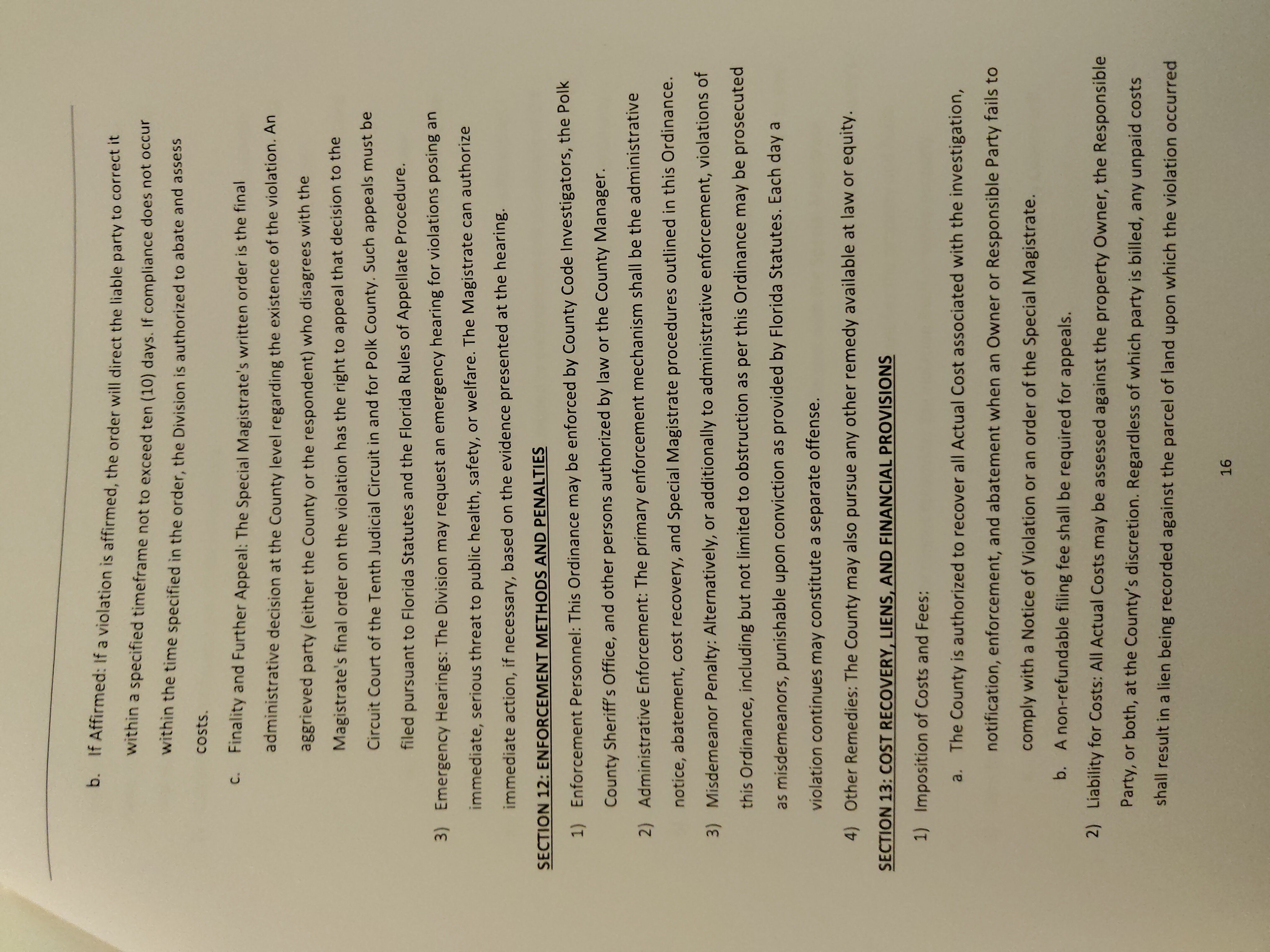
b. If affirmed, if a violation is affirmed, the order will direct the liable party to correct it within a specified timeframe not to exceed ten (10) days. If compliance does not occur within the time specified in the order, the Division is authorized to abate and assess costs.

c. Finality and Further Appeal: The Special Magistrate's written order is the final administrative decision at the County level regarding the existence of the violation. An aggrieved party (either the Owner or the Respondent) who disagrees with the Magistrate's final order on the ground that he/she has the rightright to appeal that decision to the Circuit Court of the Tenth Judicial Circuit in and for Polk County. Such appeals must be filed pursuant to Florida Statutes and the Florida Rules of Appellate Procedure.

3) Emergency Hearings: The Division may request an emergency hearing for violations posing an immediate, serious threat to public health, safety, or welfare. The Magistrate can authorize immediate action, if necessary, based on the evidence presented at the hearing.

SECTION 12: ENFORCEMENT METHODS AND PENALTIES

1) Enforcement Personnel: This Ordinance may be enforced by County Code Investigators, the Polk County Sheriff's Office, and other persons authorized by the County Manager.

2) Administrative Enforcement: The primary enforcement mechanism shall be the administrative notice, abatement, cost recovery, and Specialty procedures outlined in this Ordinance.

3) Misdemeanor Penalty: Alternatively, or additionally to administrative enforcement, violations of this Ordinance, including but not limited to obstruction as provided in Florida Statutes. Each day a misdemeanor, punishable upon conviction as provided by Florida Statutes.Statutes. Day a violation continues may constitute a separate offense.

4) Other Remedies: The County may also pursue any other remedy available at law or in equity.

SECTION 13: COST RECOVERY, LIENS, AND FINANCIAL PROVISIONS

1) Imposition of Costs and Fees:

a. The County is authorized to recover all Actual Cost associated with the investigation, notification, enforcement, and abatement when an Owner or Responsible Party fails to comply with a Notice of Violation or an order of the Special Magistrate.

2) Liability for Costs: All Actual Costs may be assessed against the property Owner, the Responsible Party, at both, or the County's discretion. Regardless of which party is …… by any unpaid costs shall in be a lien being recorded against the parcel of land upon which the violation occurred

16

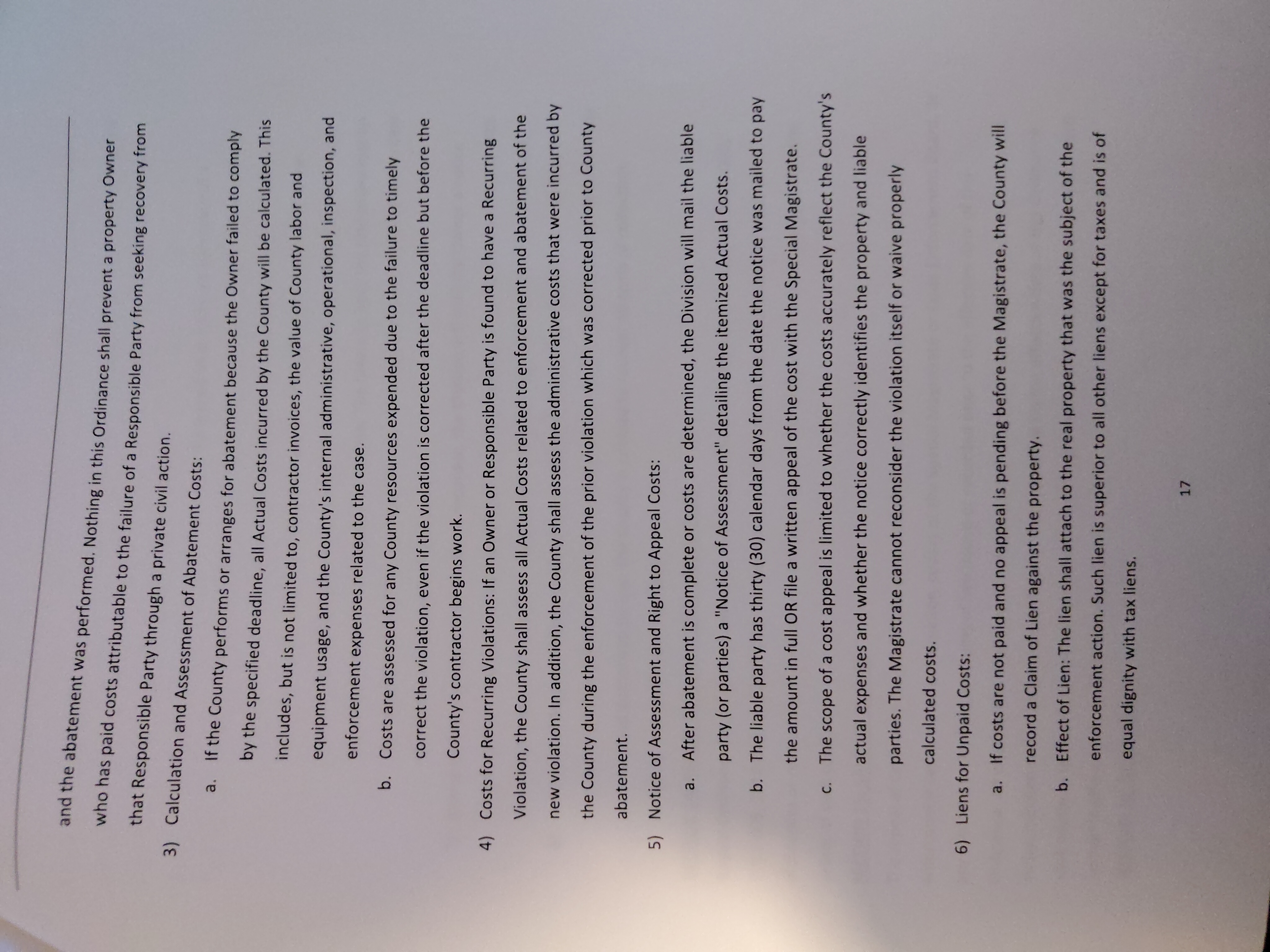
...and the abatement was performed. Nothing in this Ordinance shall prevent a property Owner who has paid costs attributable to the failure of a Responsible Party from seeking recovery from that Responsible Party through a private civil action.

3) Calculation and Assessment of Abatements Costs:

a. If the County performs or arranges for abatement because the Owner failed to comply by the specified deadline, all Actual Costs incurred by the County will be calculated. This includes, but is not limited to, contractor's invoices, the value of County labor and equipment usage, and the County's internal administrative, operational, inspection, and enforcement expenses related to the case.

b. Costs are assessed for any County Resources expended due to the failure to timely correct the violation, even if the violation is corrected after the deadline but before the County's contractor begins work.

4) Costs for Recurring Violations: If an Owner or Responsible Party is found to have a Recurring Violation, the County shall assess all Actual Costs related to enforcement and abatement of the new violation. In addition, the County shall assess the administrative costs that were incurred by the County during the enforcement of the prior violation which was corrected prior to County abatement.

5) Notice of Assessment and Right to Appeal Costs:

a. After abatement is complete or costs are determined, the Division will mail the liable party (or parties) a "Notice of AssessmentAssessment" detailing the itemized Actual Costs.

b. The liable party has thirty (30) calendar days from the date the notice was mailed to pay the amount in full OR to file a written appeal of the cost with the Special Magistrate.

c. The scope of an appeal is limited to whether the costs accurately reflect the County's actual expenses and whether this notice correctly identifies the property and liable parties. The Magistrate cannot reconsider the violation itself or waive properly calculated costs.

6) Liens for Unpaid Costs:

a. if costs are not paid and no appeal is pending before the Magistrate, the County will record a Claim of Lien against the property.

b. Effect of Lien: The lien shall attach to the real property that was the subject of the enforcement action. Such lien is superior to all other liens except for taxes and is of equal dignity with tax liens.

17

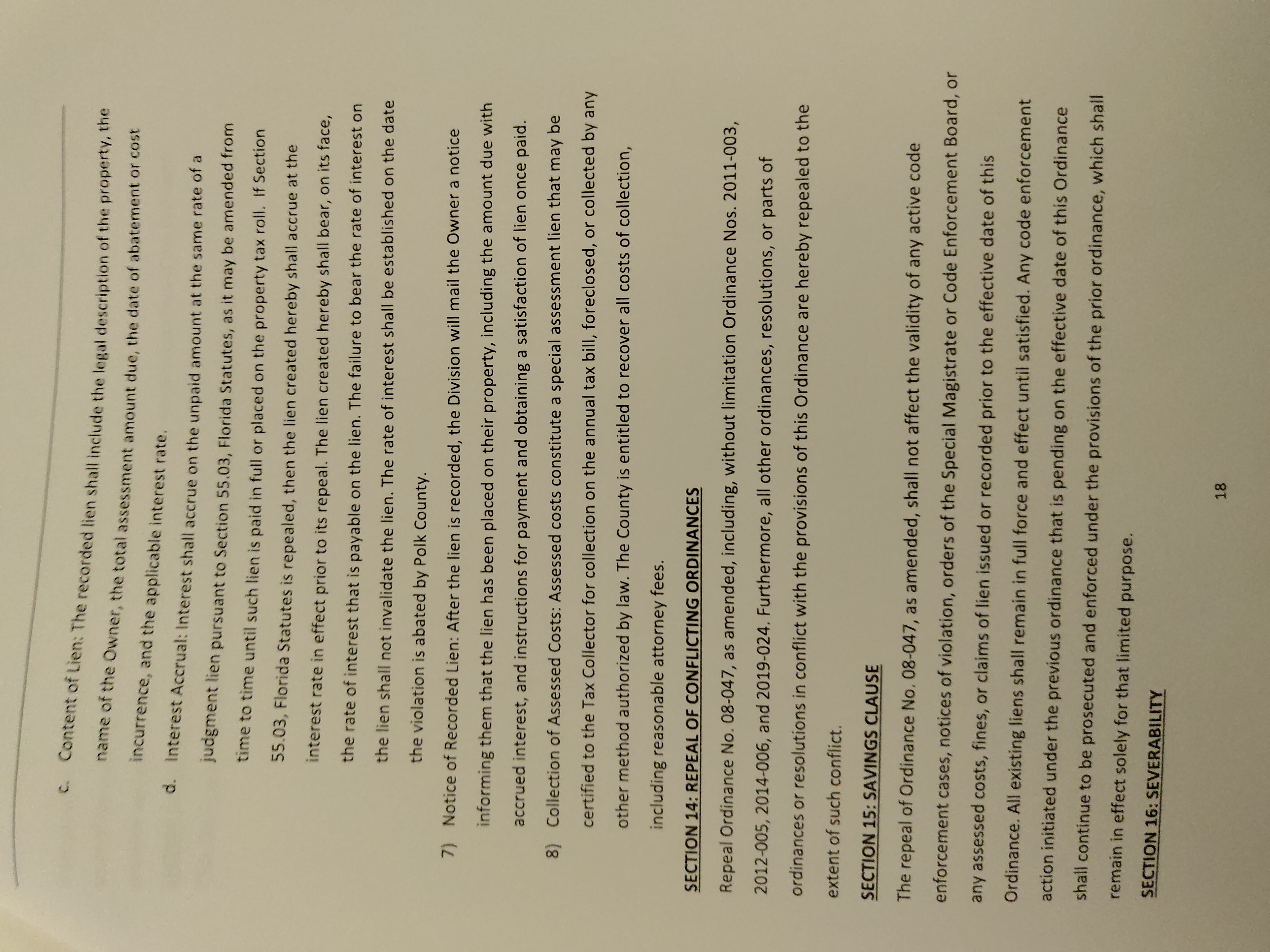
c. Content of Lien: The recorded lien shall include the legal description of the property, the name of the Owner, the total assessment amount, due the date of abatement or cost and the abatement, and the applicable interest rate.

d. Interest Accrual: Interest shall accrue on the unpaid amount at the same rate of judgment lien pursuant to Section 55, 03, Florida Statutes, as it may be amended from time to until such lien is paid in full or paid on the property tax. If such lien is placed on the property tax, the lien created hereby shall accrue at the interest rate in effect prior to the lien. The failure to bear on its face, the rate of interest that is payable on the lien. The failure to bear on its face, the rate of interest on the lien shall not invalidate the lien. The rate of interest shall be established on the date the violation is abated by Polk County.

7) Notice of Recorded Lien: After the lien is recorded, the Division will mail the Owner a notice informing him that the lien has been placed on their property, including the amount due with accrued interest, and instructions for payment and obtaining a satisfaction of lien once paid.

8) Collection of Assessed Costs: Assessed costs constitute a special assessment lien that may be certified to the Tax Collector for collection on the annual tax roll, foreclosed, or collected by any other method authorized by law. The County is entitled to recover all costs of collection, including reasonable attorney fees.

SECTION 14: REPEAL OF CONFLICTING ORDINANCES

Repeal Ordinance No. 08-047, as amended, including, without limitation Ordinance Nos. 2011-003, 2012-005, 2014-006, and 2019-024. Furthermore, all other ordinances, resolutions, or parts of ordinances or resolutions in conflict with the provisions of this Ordinance are hereby repealed to the extent of such conflict.

SECTION 15: SAVINGS CLAUSE

The repeal of Ordinance No. 08-047, as amended, shall not affect the validity of any other code enforcement cases, notices of violation, orders of the Special Magistrate or Code Enforcement Board, or any assessed costs, fines, or claims of lien issued or recorded prior to the effective date of this Ordinance. Any code enforcement action initiated under the previous ordinance that is pending on the effective date of this ordinance shall continue to be prosecuted and enforced under the provisions of the prior ordinance, which shall remain in effect solely for that limited purpose.

SECTION 16: SEVERABILITY

18

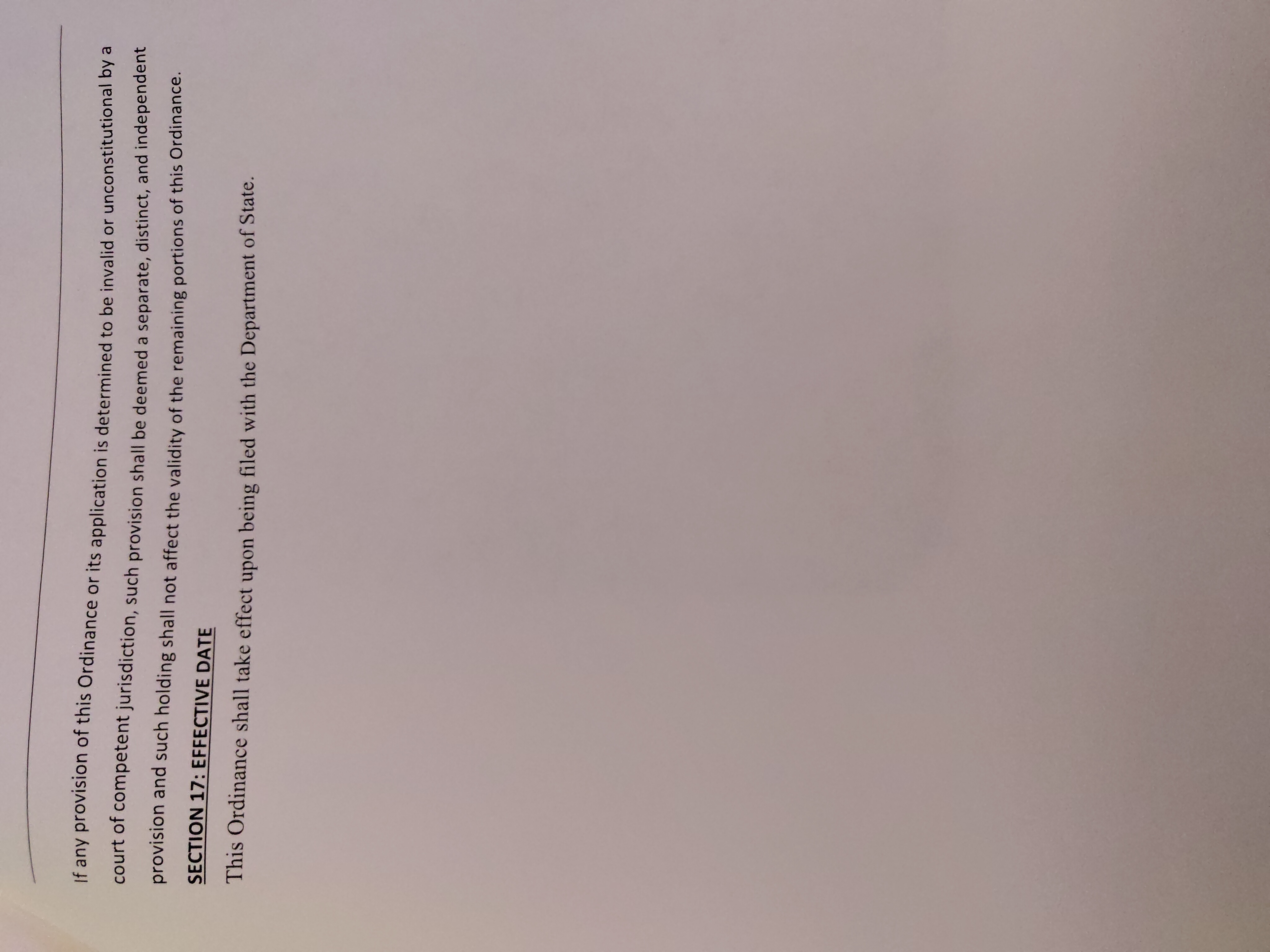
if any provision of this Ordinance or its application is determined to be invalid or unconstitutional by a court of competent jurisdiction, such provision shall be deemed a separate, distinct, and independent provision and such holding shall not affect the validity of the remaining portions of this Ordinance.

SECTION 16: SEVERABILITY

SECTION 17: EFFECTIVE DATE

This Ordinance shall take effect upon being filed with the Department of State.